

The Pokémon Trading Card Game (TCG) is one of the world’s most enduring tabletop strategy games, blending accessible rules with deep tactical decision-making. While its colorful creatures draw in new players, the underlying mechanics reward planning, resource management, and adaptation. This guide provides a structured, in-depth overview of the game’s core objectives, fundamental mechanics, and card structure, explaining how these elements interact to create the strategic identity of the Pokémon TCG.
1. Core Objectives of the Pokémon TCG
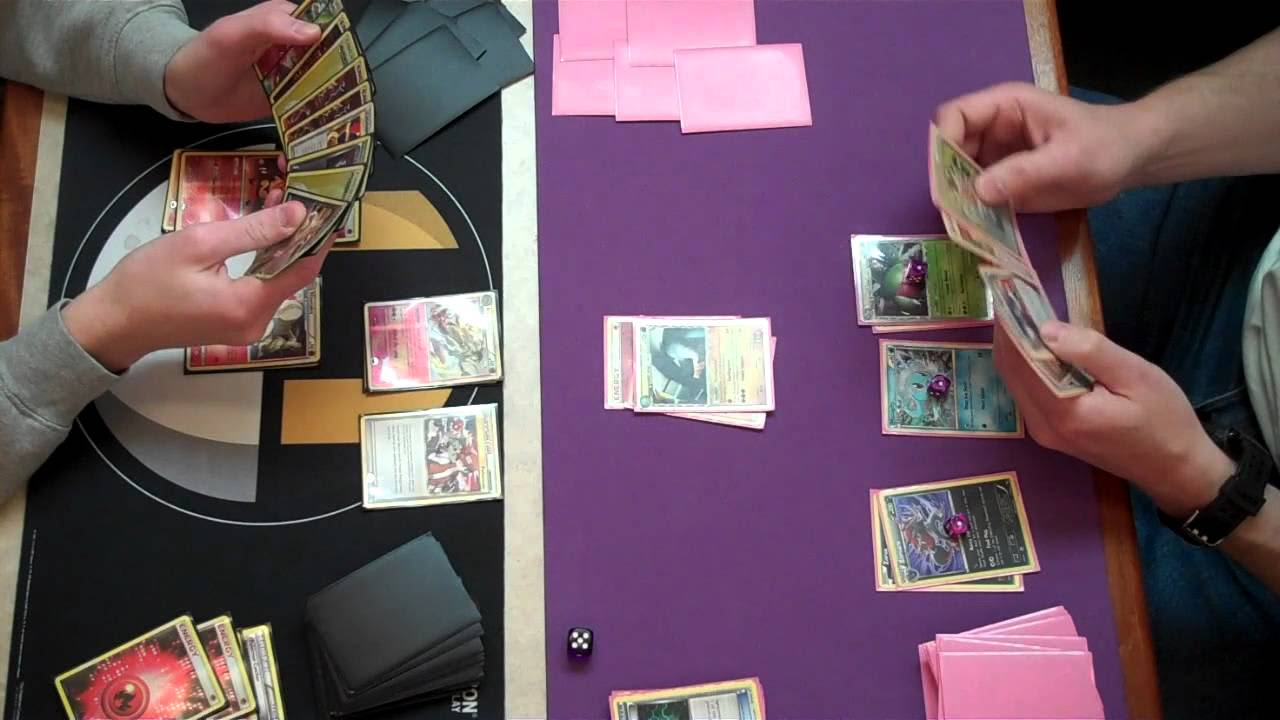
At its heart, the Pokémon TCG simulates a battle between two Pokémon trainers. Each player assembles a deck of creatures, energy resources, and trainer tools, aiming to knock out the opponent’s Pokémon and seize victory. While the primary objective can vary slightly by format, the standard win conditions are clear.
1.1 Primary Win Conditions
1.1.1 Take All Prize Cards
Each player begins a standard game with six Prize cards. Every time you knock out an opponent’s Pokémon, you take one or more Prize cards based on that Pokémon's tier:
-
Regular Pokémon: 1 Prize card -
Pokémon ex: 2 Prize cards -
Powerful Pokémon (e.g., VMAX, VSTAR): 2–3 Prize cards
The first player to take all of their Prize cards wins the game.
1.1.2 Knock Out All Opponent’s Pokémon in Play
If a player has no Pokémon remaining on their field (both in the Active Spot and on the Bench), they immediately lose the game.
1.1.3 Opponent Cannot Draw a Card at the Start of Their Turn
If a player is unable to draw a card at the beginning of their turn because their deck is empty, they lose by "deck-out."
These win conditions are simple, but achieving them requires navigating several layered systems, which are examined next.
2. Core Game Mechanics
The Pokémon TCG incorporates multiple intertwined subsystems—resource usage, board management, evolution, tempo, and risk—and packages them into a turn-by-turn structure that is easy to follow.
2.1 Turn Structure
Each player’s turn follows a predictable but strategically rich sequence.
2.1.1 Start-of-Turn Phase
-
Draw a card: This is a mandatory action. If you cannot draw because your deck is empty, you lose. -
Resolve "between turns" effects: Address any lingering effects from the previous turn, such as damage from Special Conditions like Poisoned or Burned.
2.1.2 Action Phase
During your turn, you may perform any of the following actions in any order and as many times as you like, unless otherwise specified:
-
Play Basic Pokémon: You may place any number of Basic Pokémon from your hand onto your Bench, up to a maximum of five Benched Pokémon. -
Evolve Pokémon: A Pokémon may evolve once per turn, and only if it has been in play since the beginning of your turn. Evolutions fully heal the Pokémon and often grant more powerful abilities or stronger attacks. -
Attach Energy (once per turn): You may attach one Energy card from your hand to one of your Pokémon. This action is limited to once per turn unless modified by a special ability or Trainer card. -
Play Trainer Cards: These cards provide various powerful effects. -
Supporters: Powerful cards, but you may only play one per turn. -
Items: You can play as many of these as you like per turn. -
Stadiums: These cards introduce global effects that impact both players.
-
-
Use Abilities: Many Pokémon have Abilities that can be used during this phase. These may have their own conditions or limits. -
Retreat Active Pokémon (once per turn): You may pay the Retreat Cost (by discarding the specified amount of Energy) to move your Active Pokémon to the Bench and promote a Benched Pokémon to the Active Spot.
2.1.3 Attack Phase
This is the final phase of your turn.
-
Declare an attack from your Active Pokémon. -
Pay the required Energy costs for the attack. -
Apply the attack's effects, such as damage, status conditions, or other special rules. -
Calculate final damage after accounting for the defending Pokémon's Weakness and Resistance. -
After your attack is complete, your turn ends automatically.
2.2 Combat Mechanics
Combat is the core of the game’s progression. Without attacking, you cannot take Prize cards.
2.2.1 Damage
Each attack lists a damage number (e.g., "50") or describes a variable effect (e.g., "Flip 2 coins. This attack does 30 damage for each heads."). Attack effects are applied first, followed by the final damage calculation.
2.2.2 Weakness & Resistance
-
Weakness: Typically doubles the incoming damage from the specified type. -
Resistance: Reduces incoming damage from the specified type by a fixed amount (usually -30).
2.2.3 Knockouts
If the total damage on a Pokémon is greater than or equal to its HP, it is knocked out.
-
The knocked-out Pokémon and all cards attached to it are sent to the opponent's discard pile. -
You claim the appropriate number of Prize cards based on its tier.
2.2.4 Special Conditions
Special Conditions alter the state of a Pokémon in battle, often forcing suboptimal plays and adjustments to your turn sequencing. Key conditions include:
-
Poisoned: The Pokémon takes damage between turns. -
Burned: The Pokémon may take damage between turns. -
Asleep: The Pokémon cannot attack or retreat. -
Paralyzed: The Pokémon cannot attack or retreat. -
Confused: The Pokémon may damage itself instead of attacking.
2.3 Resource Management: The Energy System
The Pokémon TCG’s energy attachment system is the primary pacing mechanism of the game, dictating the tempo of play.
2.3.1 Energy Types
Each Pokémon type has a corresponding Energy type. The main types are Grass, Fire, Water, Lightning, Psychic, Fighting, Darkness, Metal, Dragon, and Colorless.
2.3.2 Energy Attachment Limits
-
A player may only attach one Energy card from their hand to a Pokémon per turn, unless an ability or Trainer card allows for extra attachments. -
Attaching the correct type of Energy is essential for a Pokémon to use its attacks.
2.3.3 Energy as Tempo
Because powerful attacks often require multiple Energy cards, players must constantly make strategic choices about resource allocation:
-
Do you build up a powerful attacker slowly over several turns? -
Or do you use low-cost attacks for early aggression and pressure?
Well-timed Energy attachments are often the difference between winning and losing.
2.4 The Evolution System
Evolution provides a clear sense of progression and power increase during a match.
-
The standard evolution path is Basic → Stage 1 → Stage 2. -
Evolved Pokémon are stronger, possessing higher HP and more powerful attacks. -
Evolving a Pokémon also removes any Special Conditions affecting it.
This creates a mini-strategy around timing your evolutions:
-
Should you evolve early to gain a power advantage? -
Or should you hold the evolution to activate a powerful ability that triggers "when you evolve this Pokémon"?
2.5 Deck Building Rules
Constructing a valid and effective deck is the first step to playing the game.
2.5.1 Deck Size & Limits
-
A deck must contain exactly 60 cards. -
With the exception of basic Energy cards, you cannot have more than four copies of any card with the same name.
2.5.2 Deck Composition
While compositions vary, successful decks generally follow a balanced structure:
-
Pokémon: Approximately 15–25 cards -
Energy: Approximately 10–15 cards -
Trainer cards: Approximately 25–35 cards
2.5.3 Archetypes
Deck strategies, or archetypes, define a deck's playstyle. Common archetypes include:
-
Aggro/Rush: Focuses on fast, low-energy attackers to apply early pressure. -
Control/Stall: Aims to disrupt the opponent through resource denial, hand manipulation, and healing. -
Combo: Utilizes interacting card engines to set up a powerful, game-winning play. -
Tank: Relies on high-HP Pokémon with healing and damage reduction capabilities. -
Toolbox: Features a variety of Pokémon types and flexible answers to counter different strategies.
3. Anatomy of a Pokémon Card
Understanding a card's structure is essential, as each component informs how the card functions in gameplay.
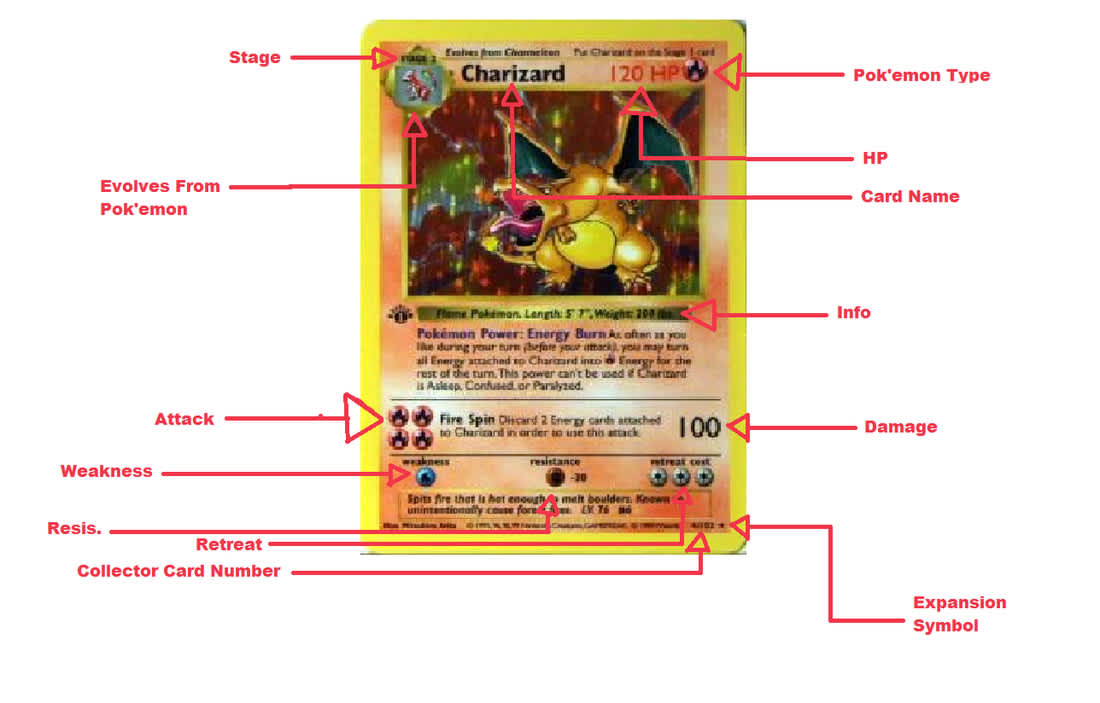
A typical Pokémon card includes the following elements:
3.1 Name
This identifies the Pokémon. Some cards may share a name but differ in abilities, attacks, or artwork.
3.2 HP (Hit Points)
Located in the top right corner, HP (Hit Points) represents the Pokémon's durability. A Pokémon is knocked out when the total damage it has received is equal to or greater than its HP.
3.3 Pokémon Type
The type influences a Pokémon's Weakness and Resistance and determines the kind of Energy required for its attacks. It also dictates synergies with other Pokémon and Trainer cards. The primary types are Grass, Fire, Water, Lightning, Psychic, Fighting, Darkness, Metal, Dragon, and Colorless.
3.4 Stage (Evolution Level)
Found in the upper left corner, the stage indicates where the Pokémon fits in an evolution line:
-
Basic: Can be played directly onto the Bench. -
Stage 1: Evolves from a specific Basic Pokémon. -
Stage 2: Evolves from a specific Stage 1 Pokémon.
Some special Pokémon, such as Pokémon ex, V, or VSTAR, include unique mechanics and are often more powerful.
3.5 Abilities
Abilities are passive or active effects that often define a deck's core strategy. Some can be used every turn, while others are limited to once per turn or have specific activation conditions. Common ability effects include:
-
Drawing extra cards
-
Accelerating Energy attachment
-
Healing
-
Searching the deck
3.6 Attacks
Each attack has three key elements:
3.6.1 Energy Cost
Icons show which types and how many Energy cards are required to perform the attack.
3.6.2 Damage
This can be a flat value (e.g., 80) or conditional (e.g., “40× the number of heads”).
3.6.3 Effect Text
The text may describe additional effects of the attack, which can include:
-
Status infliction -
Drawing cards -
Discarding an opponent’s Energy -
Searching your deck -
Damage scaling based on certain conditions
These effects create complex tactical choices.
3.7 Weakness
Typically doubles the damage received from the listed Pokémon type (e.g., ×2).
3.8 Resistance
Usually reduces incoming damage from the listed type by a set amount, commonly 30.
3.9 Retreat Cost
Found at the bottom of the card, this indicates the amount of Energy you must discard to move the Active Pokémon to the Bench. A high Retreat Cost makes a Pokémon difficult to reposition.
3.10 Rule Box (if applicable)
Special mechanics (such as for Pokémon ex, GX, VSTAR, etc.) are explained here. Cards with Rule Boxes often interact with many modern Trainer cards.
3.11 Flavor Text & Artwork
This text is informational but has no impact on gameplay. It is included for collectors and thematic immersion.
4. How Mechanics and Card Components Interact Strategically
The Pokémon TCG is fundamentally a game of resource and tempo management. Strategy emerges from the interplay of card features, deck composition, and the actions taken each turn.
4.1 Energy and Attacks: The Core Tension
Energy attachments limit your speed. High-damage attacks require commitment, creating constant decision pressure:
-
Should you build up one main attacker? -
Should you spread Energy across your field? -
Should you prioritize a backup attacker in case your main one is knocked out?
4.2 Evolution and Timing
Evolution lines create layered decision-making:
-
Do you delay evolution to use a Basic-stage ability? -
Do you evolve immediately for more HP and a stronger attack? -
Do you evolve on a specific turn to activate an ability that triggers "when evolving"?
Players must map out their evolution timing to match the opponent’s pacing.
4.3 Bench Management
With only five bench slots, space is a critical resource.
-
Which Pokémon do you prioritize placing on the Bench? -
Do you commit to a secondary attacker or leave space for utility Pokémon? -
Can you afford to have a support Pokémon taking up a valuable slot?
4.4 Trainer Card Synergy
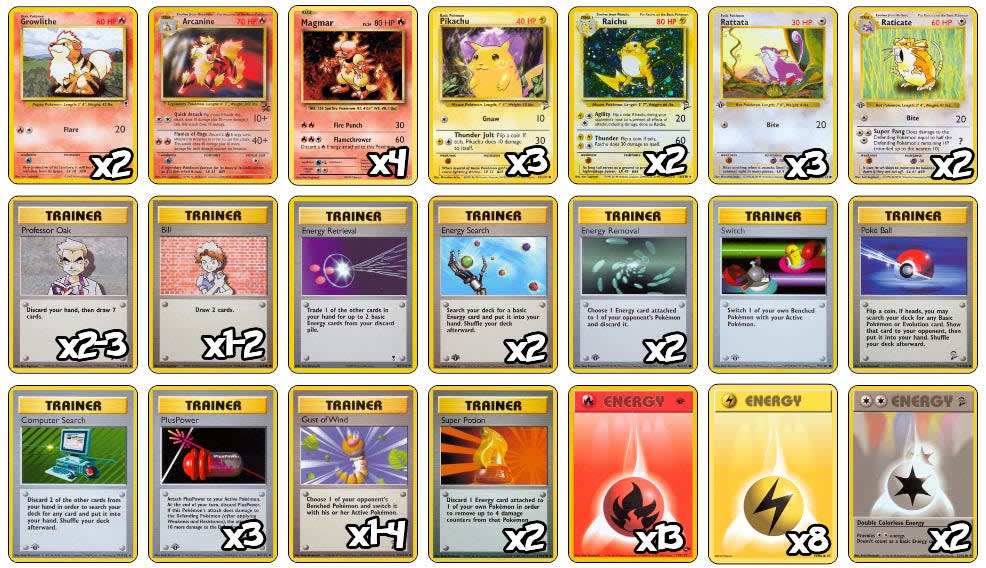
Trainer cards accelerate the game and provide consistency:
-
Drawing cards speeds up your engine. -
Search cards find the exact pieces you need. -
Stadiums influence both players and can reshape the battlefield.
Trainers are the glue that holds a competitive deck together.
4.5 Weakness and Type Matching
Weakness is a critical factor that defines matchups:
-
Some decks have natural, hard advantages over others. -
Other matchups require specific "tech" cards or playstyle adaptations to avoid an auto-loss.
A skilled player learns to navigate the battle around their weaknesses.
4.6 Prize Card Strategy
The pace at which Prize cards are taken defines the tempo of victory:
-
Multi-Prize Pokémon offer stronger abilities but risk losing the game faster if knocked out. -
Single-Prize decks rely on attrition, resilience, and overwhelming the opponent.
A key decision in deck building is whether to play high-prize, high-power cards or low-prize, more flexible ones.
Conclusion
The Pokémon Trading Card Game remains one of the most accessible yet strategically rich TCGs in the world. Its layered design—from straightforward turn actions to advanced deck archetypes—is built on a foundation of elegant mechanics: Energy pacing, evolution progression, tactical combat, and synergistic card interactions.
Understanding the core objectives, game mechanics, and card structure provides new players with the confidence to enter the game, while also offering enthusiasts and designers an appreciation for the depth behind Pokémon’s charming surface. Whether you are trying to build your first deck or studying resource-based game systems, the Pokémon TCG is a model of how simplicity and strategy can coexist in perfect balance.


